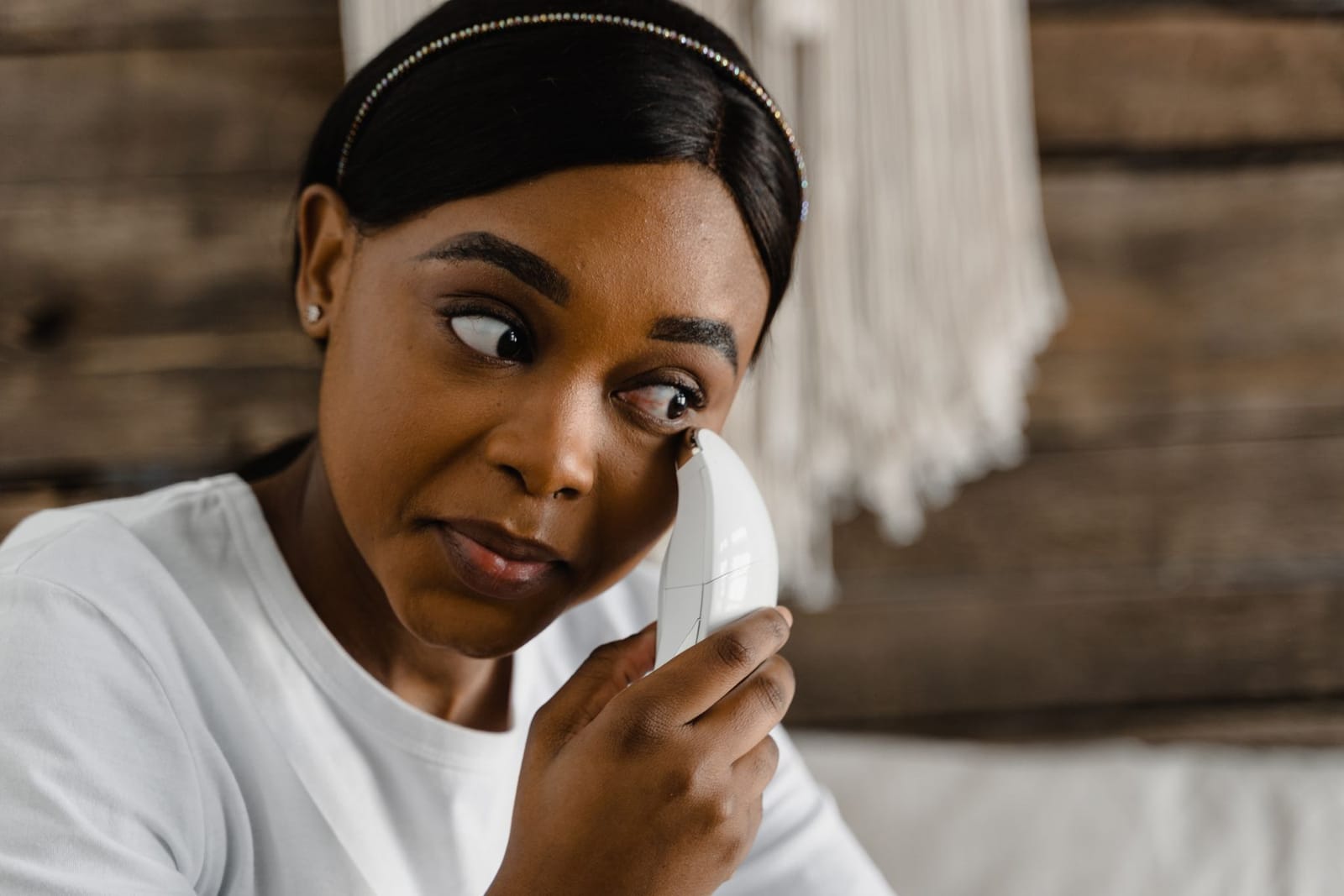
Blue Light vs Red Light Therapy: What Each Does
Red, near-infrared and blue LED do different cosmetic jobs. What each wavelength is for, how deep it reaches, and which mask modes are worth having.

Every LED mask on the market lists its wavelengths, and almost none of them explain what those numbers are for. The result is a lot of people buying a seven-mode device and cycling through colours at random. This guide sets out what red, near-infrared and blue LED are each used for in cosmetic devices, how far each one actually travels into skin, and which modes are worth your time.
Why does the wavelength matter at all?
Light behaves differently depending on its wavelength, measured in nanometres (nm - a billionth of a metre). Two things change as the number goes up: how deep the light reaches into tissue, and which molecules in the skin absorb it. Those two facts are the whole reason different colours are used for different cosmetic purposes.
Shorter wavelengths scatter and get absorbed close to the surface. Longer ones travel further before they are absorbed. That is why blue sits at the shallow end and near-infrared at the deep end, with red in between. A device that emits only blue is not a weaker red device - it is doing something else entirely, at a different depth.
The umbrella term for the red and near-infrared side of this is photobiomodulation, and the proposed mechanism is reasonably well described in the scientific literature on photobiomodulation: light in that band is absorbed by cytochrome c oxidase, an enzyme in the mitochondria, which is thought to nudge cellular energy production. That is the theory the whole category rests on, and it is worth knowing it is a theory with support rather than a settled fact.
The three wavelengths at a glance
- Blue - 415-450nm
- Shallowest. Absorbed in the epidermis. Aimed at the appearance of blemish-prone skin, via porphyrins on the skin surface.
- Red - 630-660nm
- Mid-depth, reaching the upper dermis. The most-researched cosmetic mode: the look of fine lines, tone and firmness.
- Near-infrared - 830-850nm
- Deepest, and invisible to the eye. Pitched as the deeper-working partner to red; less consumer-device evidence so far.
What is red light used for?
Red light, typically 630-660nm on consumer devices, is the mode most masks lead with. It reaches into the upper dermis - deep enough to interact with the layer where collagen sits, shallow enough that most of the energy is delivered where the visible signs of ageing show up.
The cosmetic claim is about appearance: the look of fine lines, evenness of tone, and a firmer-looking surface. Published reviews of cosmetic photobiomodulation report modest improvements on those measures with consistent use, and modest is the operative word. If you want the fuller picture on this, our honest guide to red light therapy at home covers what the research does and does not support.
Red is also the mode with the most consumer-device research behind it, simply because it has been in masks the longest. If a device only has one mode, it is almost always this one, and that is a defensible choice rather than a cost-cutting one.
What is near-infrared light used for?
Near-infrared, usually 830-850nm, is invisible. This trips people up constantly: you switch the mode on, the mask looks off or barely glowing, and it feels like the device is broken. It is not - your eyes simply cannot see that far up the spectrum. Some masks pair a token visible LED with the near-infrared array purely so you can tell it is running.
Because it is the longest wavelength in a typical mask, it travels furthest into tissue. Manufacturers pitch it as the deeper-working counterpart to red, and it is usually offered alongside red rather than on its own.
The honest position is that near-infrared has less consumer-device evidence behind it than red does, mostly because it is a newer addition to home masks. Treat a near-infrared mode as a plausible bonus rather than the reason to spend an extra hundred pounds.
What is blue light used for?
Blue light, around 415-450nm, is the shallowest of the three. Most of it is absorbed in the epidermis and very little reaches the dermis, which makes it useless for the firmness-and-fine-lines job red is used for. It is aimed at something different: the appearance of blemish-prone, congested-looking skin.
The mechanism is genuinely interesting and worth understanding, because it is not the photobiomodulation story at all. Certain bacteria that live on the skin surface produce compounds called porphyrins. Porphyrins absorb light strongly in the blue part of the spectrum, and that absorption generates reactive oxygen species which are damaging to the bacteria producing them. In other words, blue light is not energising your skin - it is being absorbed by something living on it.
Two practical consequences follow. First, blue is a surface-level tool by design, so pairing it with a rich occlusive product beforehand works against it. Second, because the effect depends on those compounds being present, blue modes are marketed at a fairly specific look rather than as a general glow setting.
Which mask modes actually matter?
Seven-colour masks are common at the budget end, offering green, yellow, purple, cyan and white alongside red and blue. The evidence base thins out dramatically past red, near-infrared and blue - those extra modes are largely a spec-sheet feature, and a mask that does two wavelengths properly beats one that does seven weakly.
What actually separates devices is irradiance (how much light energy reaches your skin per unit area) and coverage, not the number of colours in the menu. A mask with fewer, brighter, well-placed LEDs at the wavelengths that matter will do more than a rainbow with sparse diodes.
The three masks below take three different positions on this, which makes them a useful way to see the trade-off. Our best LED face mask comparison goes into the full line-up.

CurrentBody Skin LED Light Therapy Face Mask Series 2
Flexible silicone LED mask with 236 red, near-infrared and deep near-infrared LEDs, aimed at fine lines and skin tone in 10-minute sessions.
Check price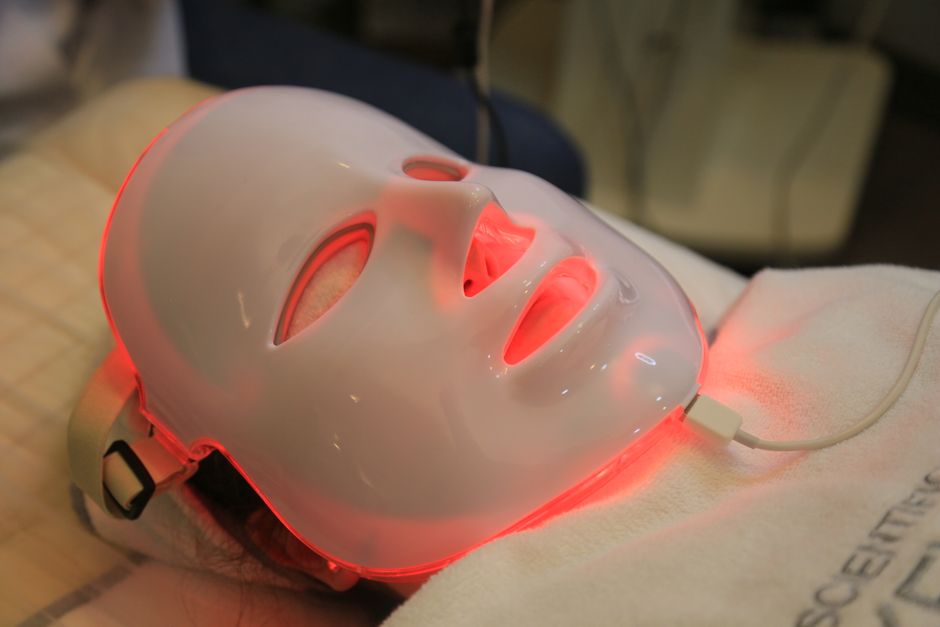
Omnilux Contour Face
Flexible medical-heritage LED mask with 132 red and near-infrared LEDs, FDA-cleared for fine lines and redness in 10-minute hands-free sessions.
Check price
Shark CryoGlow
Hard-shell LED mask with 480 red, blue and infrared lights, four preset modes and unique InstaChill under-eye cooling for puffiness.
Check priceThe CurrentBody Series 2 and the Omnilux Contour Face commit to red and near-infrared only, on the reasoning that those are the wavelengths with the strongest cosmetic case. The Shark adds a blue mode and a cooling function, which is why it reads as the more versatile device on paper - our Shark CryoGlow review looks at whether the extra modes earn their place.
Can you use red and blue light together?
Many masks offer a combined mode, and there is no interaction that makes running both a problem. The practical question is sequencing rather than safety.
Because the two wavelengths work at different depths and by different mechanisms, most manufacturers suggest alternating rather than blending - blue on the days you want the surface-level effect, red on the rest. Some devices run them simultaneously, which halves the energy each is delivering unless the LED count is high enough to compensate.
A more useful rule than any schedule: whichever mode you pick, consistency beats intensity. These are gradual, cumulative tools. Four sessions a week for three months will show you more than a fortnight of daily enthusiasm followed by the mask living in a drawer.
How do you choose between them?
Work backwards from what you actually want to change in how your skin looks.
If the answer is fine lines, tone or firmness, you want red, and near-infrared if the budget stretches - blue adds nothing to that job. If the answer is the look of blemish-prone skin, you want a device that genuinely includes blue rather than one that lists it among five decorative modes. If it is both, a red plus near-infrared plus blue device is reasonable, provided the blue is a proper array and not two token diodes.
And if you are still deciding between form factors rather than wavelengths, our LED mask versus red light panel comparison is the better starting point.
Frequently asked questions
Is blue light or red light better?
Why does my mask look dim on near-infrared mode?
Do seven-colour LED masks work better than two-colour ones?
Can I use blue light every day?
Should I put serum on before using an LED mask?
Red Light Therapy at Home: An Honest Guide
LED Mask vs Red Light Panel: Which Is Better?
Are At-Home LED Masks Worth It?